

What does the pelvic floor do?
The pelvic floor muscles stretch like a hammock from the pubic bone at the front to the tailbone at the back. They support the pelvic organs, help control the bladder and bowel, contribute to sexual function and work with the diaphragm and deep abdominal muscles to stabilise the trunk. Healthy pelvic floor muscles can contract, relax and lengthen as needed. Problems arise when they are too weak, too tight, or poorly coordinated.
Signs of a tight or overactive pelvic floor
- Pain in the pelvis, genitals, perineum, tailbone or lower back.
- Pain during or after sex.
- Difficulty starting to urinate, a weak stream or feeling of incomplete emptying.
- Constipation, straining or feeling of incomplete bowel emptying.
- Urgency or frequency of urination.
- Pain when sitting for long periods.
- In men, pelvic pain that may be labelled chronic prostatitis.
Causes
- Chronic stress and anxiety, leading to habitual clenching.
- Holding in urine or bowel movements.
- Childbirth injuries or pelvic surgery.
- Endometriosis and other painful pelvic conditions.
- High-intensity core or Kegel training without relaxation.
- Previous trauma, including sexual trauma.
- Chronic pain conditions and hypermobility.
Start with diaphragmatic breathing
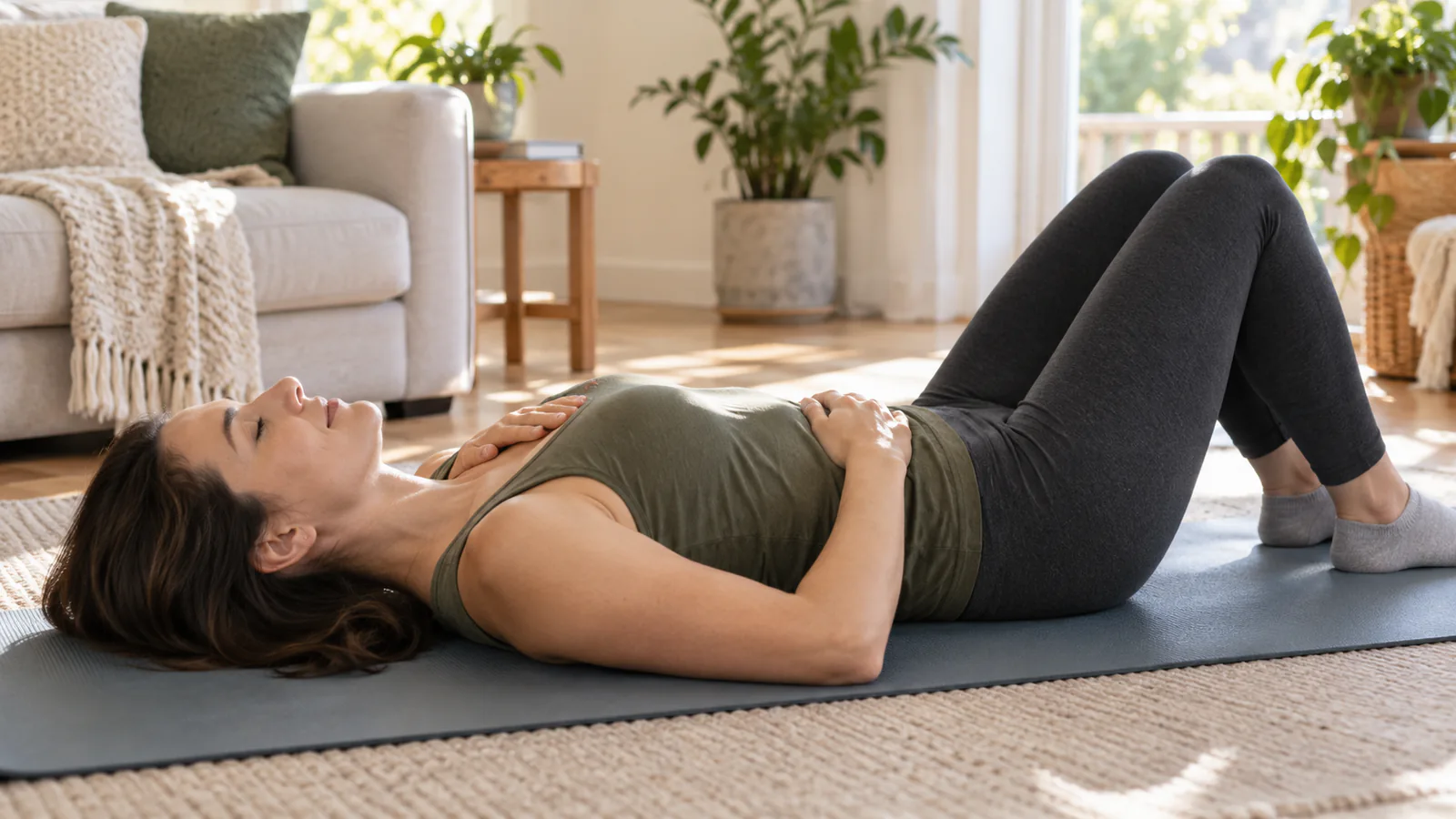
The pelvic floor moves with the breath: as you breathe in, the diaphragm descends and the pelvic floor gently lowers and lengthens; as you breathe out, both rise. Lying on your back with knees bent, place one hand on your belly and one on your chest. Breathe in slowly through your nose, letting your belly and lower ribs expand, and imagine the pelvic floor softening and widening. Breathe out gently. Practise for 5 minutes, twice a day. This is often the most important exercise for an overactive pelvic floor.
8 pelvic floor stretches
- Happy baby: lying on your back, hold the outsides of your feet with knees wide and breathe into the pelvis, 30–60 seconds.
- Child’s pose: kneel with knees wide, sit back toward the heels and breathe slowly, 60 seconds.
- Deep squat: hold onto a support and sit into a deep squat with feet flat, 30–60 seconds.
- Butterfly stretch: sitting with soles together, let the knees fall out, 30–60 seconds.
- Figure-four stretch: lying on your back, ankle over opposite knee, 30 seconds each side.
- Adductor rock-back: on hands and knees with one leg out to the side, rock back gently, 10 times each side.
- Cat–cow with breathing, 10 times.
- Legs up the wall: lie with legs supported on a wall, breathing slowly, 2–5 minutes.

Stretches versus Kegels
Kegel exercises (pelvic floor muscle training) strengthen the muscles and are recommended for stress urinary incontinence; a Cochrane review found they help women with urinary incontinence compared with no treatment. However, if the muscles are already tight, adding more contraction can increase pain and difficulty emptying. A pelvic health physical therapist can assess whether you need strengthening, relaxation or both. Strengthening for weakness after pregnancy is covered alongside our guide to diastasis recti exercises.
Helpful habits
- Do not hover over the toilet; sit fully with feet supported, ideally on a small step for bowel movements.
- Avoid straining; relax and breathe out.
- Do not hold urine for long periods or go “just in case” too often.
- Treat constipation with fibre, fluids and movement.
- Manage stress with relaxation techniques.
- Use heat on the lower abdomen or perineum for comfort.
Pelvic health physical therapy
A pelvic health physical therapist can assess pelvic floor function externally and, with consent, internally. Treatment may include relaxation and breathing training, biofeedback, manual therapy, stretching, desensitisation, education about bladder and bowel habits, and gradual return to activities. Research on overactive pelvic floor dysfunction supports a multidisciplinary approach, often combining physical therapy with medical and psychological care.
Three common situations
- Painful sex and difficulty relaxing: breathing, gentle stretches and pelvic health physical therapy often help.
- Constipation with straining despite enough fibre: a non-relaxing pelvic floor may be involved; a footstool and relaxation techniques can help.
- Leaking urine when coughing after childbirth: strengthening exercises are usually needed, ideally after assessment.
A simple daily routine
Start with five minutes of diaphragmatic breathing lying down, then choose three or four stretches and hold each for 30 to 60 seconds while breathing slowly into the pelvis. Finish with two minutes of legs up the wall. Practise once or twice a day, ideally at the same time, such as before bed. Stretches should feel gentle; sharp pain or a burning sensation is a sign to ease off. Many people find symptoms improve gradually over four to eight weeks of regular practice.
Key points to remember
- The pelvic floor needs to both contract and relax.
- Tight pelvic floors can cause pain and bladder or bowel difficulties.
- Diaphragmatic breathing and gentle stretches help relaxation.
- Kegels are for weakness; tightness needs a different approach.
Questions about pelvic floor stretches
These answers are general information and do not replace an examination or individual medical advice.
How do I know if my pelvic floor is tight or weak?
Symptoms overlap. A pelvic health physical therapist can assess the muscles and recommend the right exercises.
Can men have a tight pelvic floor?
Yes. It can cause pelvic pain, urinary symptoms and sexual problems, and responds to similar treatment.
How long does it take to relax a tight pelvic floor?
Many people notice improvement within weeks of daily practice, though longer-standing problems may take months.
Can stress cause pelvic floor tension?
Yes. Many people unconsciously clench the pelvic floor when stressed.
Should I stop Kegels if my pelvic floor is tight?
Usually yes, until you have been assessed. Relaxation and lengthening come first.
Sources
- Prather H, et al. Recognizing and treating pelvic pain and pelvic floor dysfunction. Phys Med Rehabil Clin N Am. 2007
- Dumoulin C, et al. Pelvic floor muscle training versus no treatment, or inactive control treatments, for urinary incontinence in women. Cochrane Database Syst Rev. 2018
- NHS · How to help a weak bladder (pelvic floor exercises)
This guide is for general information and does not replace medical advice. How a problem is diagnosed and treated depends on your examination and medical history. If you think you have an emergency, contact your local emergency services.